 Dodo exchange
 liquidity supports different deposit options across pool models
Updated
Dodo exchange liquidity lets providers supply one asset or a token pair, depending on the selected pool. Single-sided provision suits an existing holding only when that pool supports the deposit. Paired provision requires both assets in the proportions the pool accepts. A single-token launch also differs from adding funds after trading has changed the reserves. Compare each option by its required assets, deposit calculation, transaction costs and withdrawal output. Predictable starting amounts do not guarantee unchanged exposure or a fixed return. The useful choice begins with the pool’s funding rules and includes what happens when you redeem the resulting position.
Your available assets must match the pool’s funding rules
Holding only one asset limits the pools you can fund directly, while holding both assets gives you access to paired deposits without first acquiring the missing side.
Single-sided provision
Some pool models accept a deposit of one asset. DODO V1 introduced separate funding for the two sides of a market, with single-asset deposits and withdrawals. That design does not describe every later pool. Most non-stablecoin V1 trading pools underwent deprecation and migration, so an older explanation of unilateral deposits cannot establish a selected pool’s present funding rules.
Paired provision
The DODO Stable Pool, or DSP, uses both assets for entry and exit. Standard pool creation also requires two tokens. For either choice, having both tokens is only the starting condition: the required quantities must fit the particular pool.
The deposit preview and the resulting position answer different questions
A deposit preview describes the proposed contribution, while the resulting liquidity position establishes what the account actually holds after execution. Approval alone does not establish that position.
DODO’s Pools interface supports selecting a pool and opening its Add control. The deposit details identify the required tokens, amounts and applicable slippage setting. Token permissions may require a separate approval before the deposit transaction. My Liquidity displays positions after successful provision. Match the position to the selected account and pool, especially when comparing several options. A swap receipt concerns exchanged tokens; liquidity provision requires confirmation of the funded position.
A single-token launch can become a paired funding requirement
A DODO Vending Machine, or DVM, can start with one token, but subsequent funding depends on its reserves. Trading can introduce the second asset into the pool.
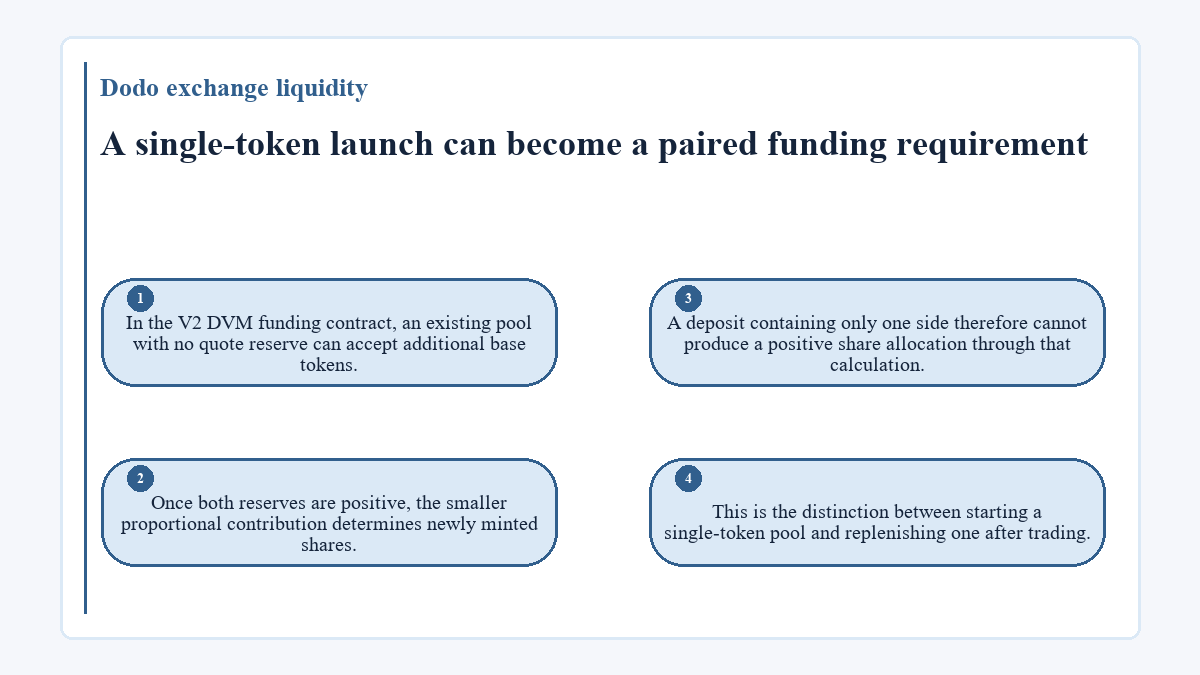
In the V2 DVM funding contract, an existing pool with no quote reserve can accept additional base tokens. Once both reserves are positive, the smaller proportional contribution determines newly minted shares. A deposit containing only one side therefore cannot produce a positive share allocation through that calculation. This is the distinction between starting a single-token pool and replenishing one after trading.
Deposit costs include asset preparation and contract execution
The cost difference between deposit options comes from the transactions they require and any asset conversion needed beforehand. Counting the deposited assets does not establish the cheaper path.
Acquiring a missing token adds a separate exchange. Its execution price, trading charges and network fee affect the total preparation cost. A direct paired deposit avoids that preliminary conversion when the account already holds suitable quantities. Existing token allowances can also change how many approval transactions the account needs.
Contract execution has its own cost. Gas consumption and the network’s fee conditions influence the amount payable. A failed on-chain execution can consume gas without creating a liquidity position. The transaction estimate therefore belongs beside the deposit amounts when comparing what each path requires.
Fee income follows a different calculation. The liquidity provider fee varies by pool, and providers receive it according to their pool share. Trading activity determines whether the pool collects those fees. A higher fee setting alone cannot establish a higher return because it says nothing about the volume the pool will process.
A paired deposit with a changed input requirement
In this hypothetical comparison, an account holds both tokens a public pool requires and keeps separate funds for network fees. Its owner wants a verified liquidity position before committing further funds. All balances, quoted quantities and transaction estimates in this example are hypothetical; no particular token pair or live rate is assumed.
The owner compares a supported single-sided option with a paired option. The account already holds the paired option’s required quantities, so that path needs no preparatory swap. The owner selects it after reviewing both token amounts, the deposit conditions and the wallet’s transaction estimate.
The owner completes any necessary approvals before depositing. The deposit then succeeds, and the account’s liquidity position appears for the selected pool. The owner checks that position against the confirmed transaction before supplying more funds. The owner records the actual transaction fee separately.
A refreshed paired quote could instead require more of one token than the account holds. The owner stops before authorizing the deposit. Reducing the contribution to an amount both balances support allows a fresh comparison; acquiring more tokens would introduce another exchange and its costs. If an approval already succeeded, stopping the deposit does not remove that permission. The owner resumes only when a new deposit preview shows amounts both token balances cover, then confirms the resulting position before supplying more funds.
Does depositing one token keep the position’s value unchanged?
A single-token input does not fix the position’s value. The funding model determines the exposure after entry, and market movements can reduce the value of the deposited capital.
Trading changes pool inventory
The Proactive Market Maker, or PMM, adjusts quoted prices in response to inventory changes. Its parameters control how strongly prices respond. A provider’s outcome therefore involves the pool’s trading activity and inventory, alongside the market value of its assets. Impermanent loss describes underperformance relative to holding the comparison assets outside the pool. Single-sided entry does not establish universal protection against that loss.
Vault funding introduces borrowing exposure
DODO V3 separates liquidity providers’ vault deposits from strategy providers’ market-making pools. Borrowing generates interest for vault depositors, with rates responding to asset utilization. This differs from directly owning a share of a paired trading pool. Bad debt remaining after liquidation can create losses for vault liquidity providers. The ability to supply an individual asset therefore comes with a different source of income and a different risk mechanism.
Withdrawal terms complete the deposit comparison
Withdrawal output follows the position’s rules and the pool’s state at redemption. A predictable deposit composition does not establish an identical composition at exit.
For a V2 DVM position, redeeming shares returns proportional amounts of the pool’s base and quote balances. Trades can change those balances while the position remains open. DSP also uses paired withdrawals. If the intended destination is a single asset, converting the other withdrawal asset adds a separate exchange with its own execution conditions.
V1’s single-sided withdrawal mechanism has a different cost condition. A V1 withdrawal of an asset already in short supply incurs an inventory-related penalty. That mechanism compensates remaining providers for the withdrawal’s effect on the pool. Compare the proposed withdrawal amounts and applicable charges before treating single-sided entry as the simpler complete route. Entry convenience and exit cost answer different parts of the decision.
Private pools change who can contribute
A private pool is a separate choice because its creator controls liquidity provision and can adjust its parameters. Finding an attractive market does not make that pool open to outside deposits. Public provision fits contributing to an existing pool; operating a private pool also requires managing its funding and pricing settings. A concrete example of that restricted funding model is the DODO Private Pool, or DPP.
Dodo exchange liquidity FAQ
Why can the same token pair have several liquidity pools?
Separate pool contracts can serve the same token pair. Their funding models, fee settings and liquidity can differ, so a pair name does not identify a unique deposit destination. Compare the individual pool details and contract identity before assuming two search results accept the same contribution.
Is holding the DODO token required for every liquidity deposit?
Liquidity provision requires the assets the selected pool accepts, rather than a universal holding of the DODO token. A pool involving that token can require it as an input. Keep the pool’s deposit assets separate from any additional conditions a particular incentive program applies.
Can I create a DVM liquidity position by transferring tokens directly to its contract?
A token transfer alone does not mint DVM liquidity shares. The funding operation must calculate and mint the shares to establish the position. Use the supported deposit operation rather than treating an ordinary transfer to the pool address as a completed liquidity contribution.
Does a pegged pool guarantee that its tokens retain their target prices?
A pegged pool’s pricing curve does not guarantee the external value of either token. The curve concentrates liquidity around an intended exchange relationship, while each asset’s backing or stabilization mechanism determines whether that relationship remains economically sound. Two-token entry does not remove exposure to a broken peg.
In which asset does a DODO V3 vault deposit earn interest?
DODO V3 calculates interest in the deposited asset itself. Each supported asset has its own utilization-dependent interest rate, so deposits of different assets need not earn at the same rate. This interest comes from borrowing within the funding model, rather than directly allocating a paired pool’s trading fees.